
My Innovative Technology Lesson
- emilyvcourt
- Jun 15, 2025
- 3 min read

Updated: Sep 6, 2025
For a lesson that I have been designing, I needed to learn about and use a new innovative technology. I chose to use a 3D pen, specifically the SCRIB3D Advance 3D pen. I had never used one before, so trying it out for the first time came with multiple failures, but then successes! For my lesson, I wanted my students to create a 3-dimensional representation of a famous landmark using this pen. Using a 3D pen can help grow someone’s creativity and problem-solving skills (Chun, H, 2022). In order for my students to do this though, they needed more information about what their landmark looks like and why it was created. All of this ties to our unit about culture.
To see my lesson plan, click here. Included in this document are the directions and templates students will need.

As I was designing this lesson, I received feedback from others through the lens of the Universal Design for Learning (UDL) and Intersectionality. I also looked at other innovative technology lessons that were in the process of being created and gave feedback while keeping those in mind as well. There are three key parts to UDL: engagement, representation, and action/expression. While giving feedback and looking at my own, the engagement section of UDL was the easiest to accomplish because of the centering around technology. All of us chose an interactive technology for our students to use, which helps follow several of the guidelines for engagement. New technology is exciting, challenging, adds play to the lesson, and gives choices to the students for what they are creating. As for the other two sections, representation and action/expression, there was more room for improvement. While looking at the lesson plans from the view of intersectionality, there were a lot of different perspectives to consider. Many of the changes that I made focused on the perspective of students with learning disabilities. I had gotten some good feedback, and I wanted to add more general guides to help students. There were some accommodations that I added, such as additional time and a screen reader software, which can help them read the various websites and makes learning more accessible (Gin, L.E. et al., 2020).
I went back and added more detail in the worksheets/direction sheets that would be provided to students. In the notesheet that they will fill out while researching, I added additional leading questions that will help them narrow down what they are looking for and what I am expecting them to know. Preparing these documents was where I spent most of my time making changes. I wanted to provide more scaffolding and support systems for those who need it.
Another section that I added to was in the assessment portion of the lesson plan. When I originally designed my lesson, I did not consider how I would help the students who were struggling to meet the learning goals. I went back though and added some things to help struggling students, such as a checklist to keep them on task and some links to websites that can help steer them in the right direction for the research portion. I also added that students can make revisions to their projects after they are given feedback.
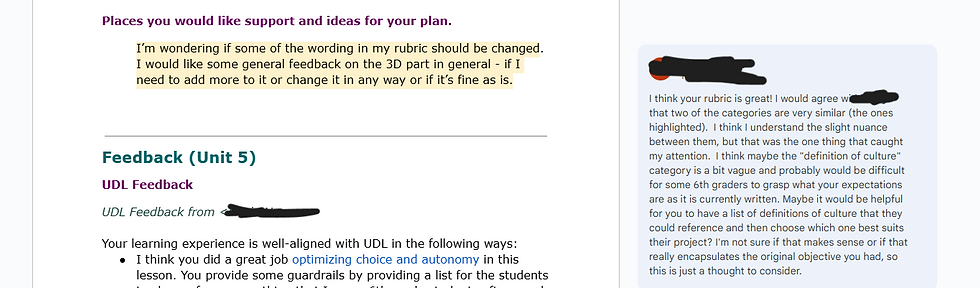
There were some things that I ended up not changing. For the most part, I kept my rubric the same. It was fairly detailed when I first created it, so I did not need to add anything. What I did change was in the “Definition of Culture” section. I had gotten some comments that it was very similar to one of the other categories. I made a small change to it to clarify the difference, but I did not add choices of definitions for them to choose from, as was suggested by someone. I did not add this because I wanted to see that my students could define the word on their own or look it up first and then put it in their own words.
Overall, I am happy with this lesson. It is important to consider UDL and intersectionality while designing activities and keeping them in mind while adjusting this lesson has made it better.
References:
Gin, L.E., Guerrero, F.A., Cooper, K.M., Brownell, S.E. (2020). Is Active Learning Accessible? Exploring the Process of Providing Accommodations to Students with Disabilities. CBE - Life Sciences Education, 12. https://www.lifescied.org/doi/pdf/10.1187%2Fcbe.20-03-0049
Chun, H. (2022). A study on the design education method using 3D pen in an era of manufacturing change. Nanotechnol. Environ. Eng. 7, 461–465. https://doi-org.proxy1.cl.msu.edu/10.1007/s41204-021-00174-5


Comments